Repetitive and complex processes are where the time actually goes. Automate them and the whole cycle runs faster, the same way every time, whether it is month end, a peak week, or an ordinary Tuesday.
What is left over is the exception. We surface those sooner and put the context next to them, so the person deciding has what they need and the business can respond while it still matters.
A relaxed conversation first. If the answer is that you do not need us, we will say so.
Every step works. The process still takes a week.
Most of the elapsed time in a business process is not spent doing the work. It is spent waiting: for the next person to pick it up, for a batch to run overnight, for somebody to notice that something needs a decision.
The same process also produces a different result depending on who ran it and how busy they were that day. Quality becomes a function of workload, which is why the errors cluster at exactly the moments you can least afford them.
The exceptions that genuinely need a person are found late, usually by the customer or at month end. By the time anyone has the context to decide, the cheap options have gone.
of respondents name workflow automation and task routing as the AI use case delivering the most value, ahead of every other category.
SAPinsider, June 2026
The gain is in the handoffs, not the keystrokes. When a step finishes and the next one starts immediately, the cycle time falls by more than the sum of the tasks you automated.
A process that runs the same way on a quiet Tuesday and on the last day of the quarter is worth more than a fast one. Consistency is what makes the output trustworthy enough to act on.
Automation does not remove judgement, it concentrates it. The value is that your people see the thirty cases that need deciding rather than the three thousand that do not.
We do not implement Joule or SAP AI Foundation, and we do not build ML models. We also will not take on a process the business cannot describe: if nobody can say what the rule is, automating it just encodes the confusion.
More machinery is not better automation. We start at the bottom of this list and only move up when the rung below genuinely cannot do the job, because every step up costs more to build, more to run and more to govern.
Some processes should be simplified, merged or retired rather than made faster. Automating a step that should not exist just makes the wrong thing happen more often.
Standard SAP does more than most estates have switched on. If the requirement is met by configuration, that is the version your team can change without us.
Rules, workflow, events and scheduled jobs. The behaviour is defined, repeatable and testable, and it runs under the authorisations and audit trail you already have. This is where most of the work belongs.
Reserved for work that is genuinely non-deterministic, such as reconciling an exception queue where the next step depends on the case. It costs more per run and it needs its own oversight, so we use it where nothing below it will do, with a person still deciding.
Most SAP estates are running more than one of these at once. We work across all four, so where a process lands is decided by the rule above rather than by what we would rather build in.
The low-code option on BTP, for approvals and forms that sit across systems. It is quick to stand up, and it stops being quick the moment a process touches your own extensions.
In-stack and clean core, so automation is covered by the same authorisations and audit trail as the transaction it is automating.
Classic SAP Business Workflow still runs a great deal of real work on ECC and on-premise S/4HANA. It is worth keeping until there is a reason to move, and it is worth someone understanding it in the meantime.
For teams who would rather not have a vendor sitting between them and their own automation. Robot Framework and the Python ecosystem around it, running on infrastructure you control.
Automation usually has to reach something outside SAP. We advise on and implement across SAP's own integration services and the third party platforms you may already be running.
Already included in a good deal of what you pay SAP for, and often switched off because nobody had time to look at it.
Where the estate is genuinely mixed, or where a platform is already in the building because another department bought it.
Not an exhaustive list. If you already own a platform, that is where we start.
Partnered with a healthcare provider in Africa to replace error-prone manual processes with a custom barcode scanning and printing solution, giving their teams accuracy and speed on the floor.
Helped a retailer take a significant step forward on their automation journey with an OCR-powered AP solution and custom workbench, dramatically reducing manual invoice processing time.
Built custom workflow integrations for SAP Build Process Automation, connecting approval and business processes that standard tooling left disconnected.
Built a custom RAP application that leverages the Application Job Framework to automate secondary master data, streamlining PLM data and ensuring efficient order management.
Longer form notes on the same problems, published on Medium.
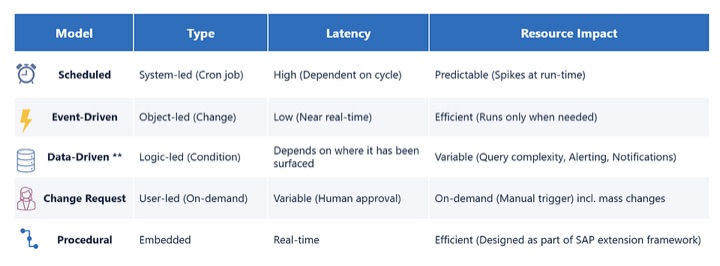
Choosing the right automation trigger and using the Application Job Framework for clean-core S/4HANA extensions with BRF+ decision tables.
Read Blog ↗
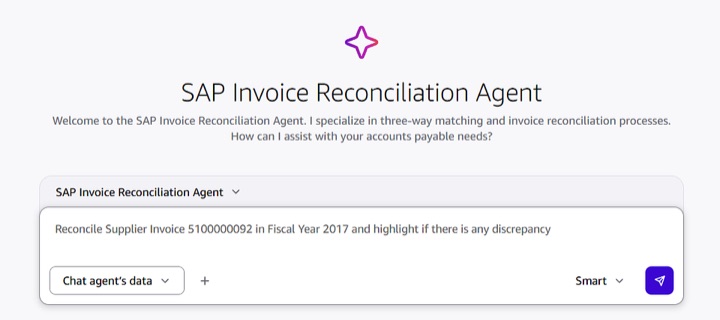
Where agents genuinely help in ERP: the exception queue nobody enjoys working, handled with a person still deciding.
Read Blog ↗

Wrapping OData services in a single reusable iFlow, instead of building a new integration every time something needs to talk to SAP.
Read Blog ↗Most of what slows a business down does not need a model. It needs somebody to automate it properly.
Curious what a custom SAP solution could look like for your company? →A relaxed conversation first. If the answer is that you do not need us, we will say so.