AI collapsed the cost of writing software. Work that was too small to justify a project last year now pays for itself.
So the question changed. Not can we afford to build it, but do we know what to build, and do we have the tooling set up to deliver it clean.
Scoping is free, and the proposal carries the price before you commit.
We help your team take advantage of recent innovations to accelerate development timeframes.
A working prototype is easier than ever. The harder questions come next. Does it fit the business? Will it scale? Can it integrate? Is it secure? Can your team maintain it?
The real challenge is not whether AI can build something, but whether it can create outcomes people and businesses value. Utility, relevance and trust are still human decisions. That is where engineering matters.
Most SAP teams are still building the way they always have. Meanwhile the tools for writing software have changed completely, and very little of that has reached the ABAP stack.
The gap is not talent, it is setup. AI-assisted development only earns its keep once the tooling knows your landscape: your objects, your naming, your released APIs and your clean core rules. Without that it produces plausible ABAP that fails review, which is the usual reason a team tries it once and goes back.
That setup is the work. We configure it against your own system, build real backlog items alongside your developers, and leave the method behind so the throughput stays after we have gone.
Speed is only useful if the output survives review. We increase the rate of sustainable development rather than the rate of code.
AI that understands your architecture, your naming, and your extension patterns produces code that survives review.
The point is not that we are faster. The point is that your developers are, after we leave.
We do not run S/4HANA conversions. We do not do functional redesign. We will not build something you should buy. We are not an AI research lab. We configure working tooling for SAP development.
Built a custom RAP application that leverages the Application Job Framework to automate secondary master data, streamlining PLM data and ensuring efficient order management.
Conducted a technical review and optimisation of a custom RAP application for delivery and receipting processes, helping the client’s team understand what they had and how to take it further.
Used AI analysis to work through a legacy mobile estate and establish what could move to SAP BTP, what needed rebuilding, and what could simply be retired.
Applied AI-assisted analysis to custom code remediation on an S/4HANA upgrade, the line that usually carries the most effort and the least certainty in the plan.
Longer form notes on the same problems, published on Medium.
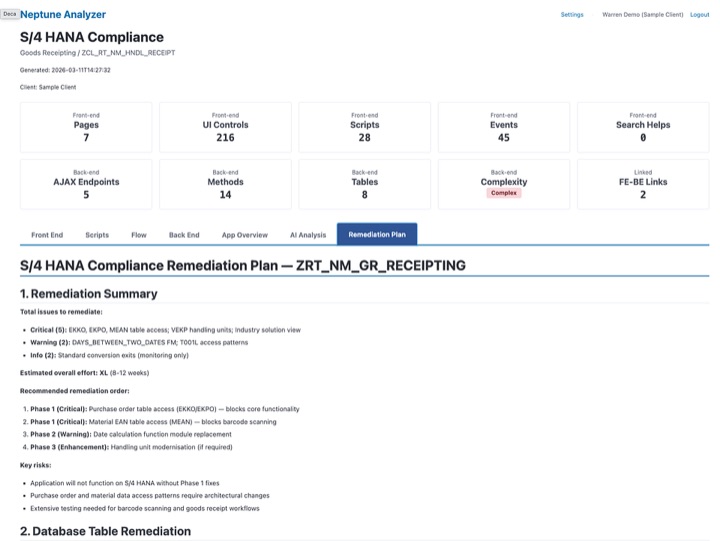
How we used AI and Python parsing to estimate remediation effort for Neptune Software applications migrating to S/4HANA.
Read Blog ↗
Hooking into standard SAP events with RAP, so an extension reacts to the business process instead of polling for it.
Read Blog ↗
Running several AI agents against one SAP codebase without them tripping over each other, and keeping a human on every deliverable.
Read Blog ↗
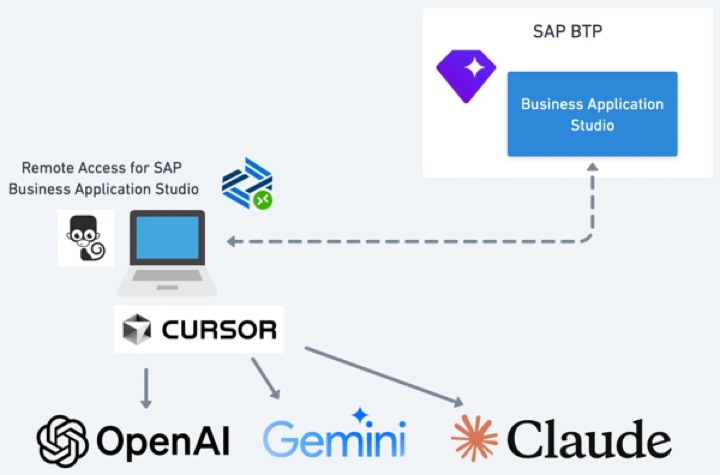
Configuring Cursor with the context a CAP project needs, so the generated code fits the project rather than the general case.
Read Blog ↗
Practical notes from building with MDK, including the things that are obvious only after you have hit them.
Read Blog ↗Scoping is free, and the proposal carries the price before you commit.